Industrial 6000 LPH RO Plant: Large-Scale Water Purification
Engineered for massive infrastructure requirements, our 6 Tonne RO system provides an exceptional 60,000+ liters per day. This flagship model is the preferred choice for central water treatment in industrial estates, large-scale pharmaceutical manufacturing, and mega-residential townships.
Ideal Use
Large Infrastructure
Output
6,000 Liters/Hr
Best For
Pharma / Estates / Mega-Mills
6000 LPH Industrial
Mega-output treatment system
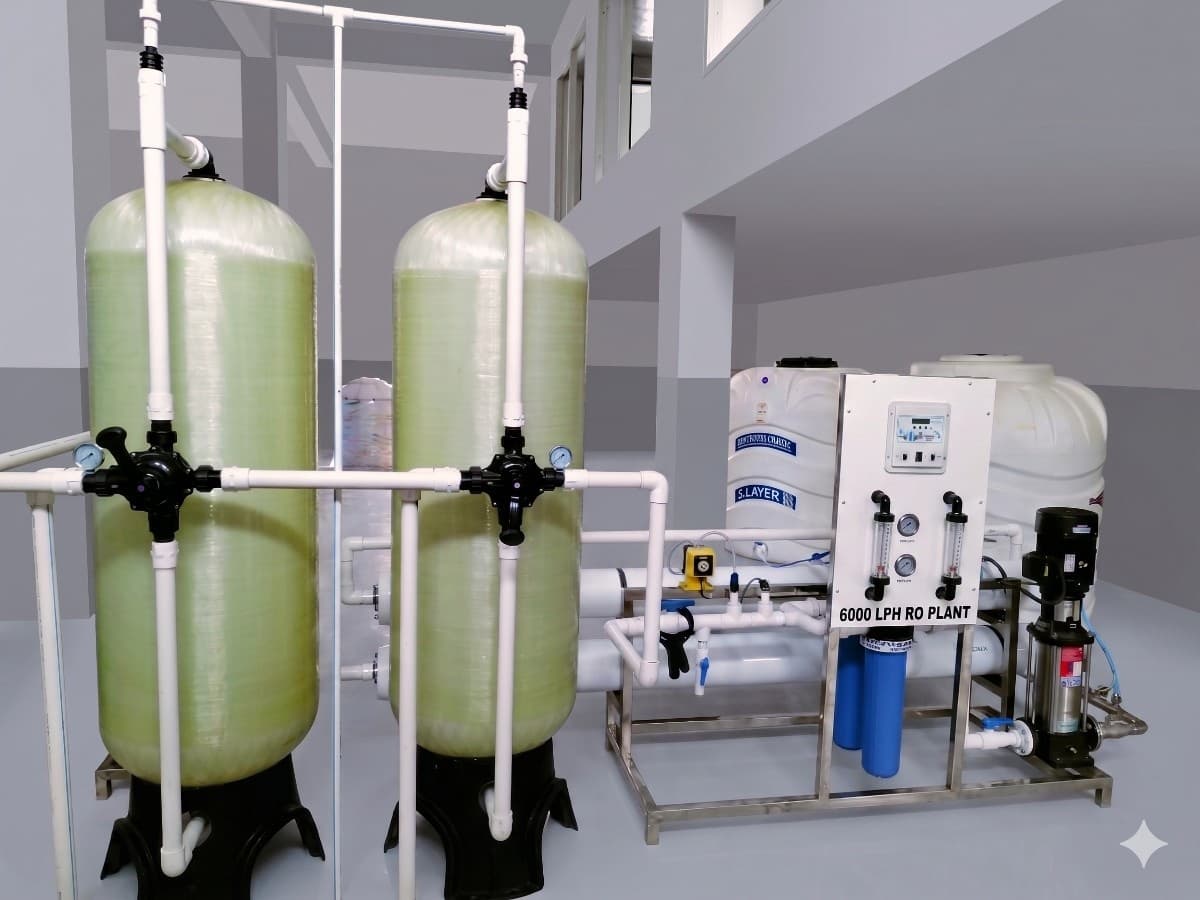
Filtration Flow
High-Flux Capacity
Automation
PLC + HMI + IoT
Membrane Spec
Industrial 8040 BW
Reliability
24/7 Enterprise Ready
When a 6000 LPH RO plant is the right choice
A 6000 LPH RO plant is built for ultra-heavy industrial operations and mega-scale facilities that require massive, uninterrupted water supply for critical production, cooling, and utility systems.
Giant factories, mega manufacturing complexes, power generation.
Highest capacity before custom industrial engineering.
A 6000 LPH RO plant represents the upper limit of standard industrial capacity, serving massive manufacturing complexes, power generation facilities, and ultra-large commercial operations where water demand reaches extraordinary levels.
This capacity powers giant factories, extensive power plants, mega food processing plants, large-scale chemical production facilities, and landmark commercial developments where water supports critical cooling systems, process requirements, and thousands of daily users.
Ultra-heavy duty note
Engineered for extreme conditions with heavy-duty construction, advanced redundancy, comprehensive automation, and industrial-grade pretreatment systems.
The 6000 LPH RO:Dominating high-volume demand
The 6000 Liters Per Hour (6 m³/hr) plant is engineered for the highest tier of industrial performance. Capable of a massive 1,44,000 liters per 24-hour cycle, this infrastructure hub powers heavy manufacturing, centralized municipal supply, and large-scale pharmaceutical production. It represents the pinnacle of hydraulic engineering, balancing high-velocity throughput with pinpoint chemical precision.
Hydraulic Metrics
Constant Purity Flow
100 L/Min
High-speed recovery for mega-reservoirs
Max Asset
Optimized per-liter utility cost
Smart PLC
Fully autonomous process management
The 6 m³/hr Strategic Powerhouse
At this scale, the 6000 LPH plant utilizes dual-membrane stage logic to deliver a constant 1.66-liters-per-second stream. This ensures that even the largest industrial cooling or process tanks are filled rapidly, maintaining the pace of your high-speed production lines.
Enterprise Rigidity
Reinforced structural skid using heavy-gauge SS-304/316 sections. Designed to withstand high pressure pulses and 24/7 industrial vibration cycles.
Peak Economy
At 6000 LPH, the "Bulk-to-Price" ratio is maximized. This plant provides the optimal balance between initial capital outlay and long-term utility savings.
SCADA-Ready Panel
Equipped with a high-end PLC controller and HMI touchscreen. Supports Ethernet/Modbus integration for centralized factory monitoring and control.
Utility Resiliency
Designed with maintenance-first architecture. Featuring bypass logic and easy-access membrane banks to keep your water flowing even during service intervals.
Who should buy a 6000 LPH RO plant
A 6000 LPH RO plant is built for sites that operate at infrastructure scale, where water purification must support not only production but also distribution, utilities, and high-occupancy demand. It is a strong fit for organizations planning a central water treatment asset rather than a department-level system. [web:126][web:129][web:131][web:137]
Pharma Companies, Electronics & Precision Process Plants
A compelling choice for pharma companies, electronics facilities, and precision manufacturing plants that require stable, high-quality purified water for process use, cleaning, formulation support, and contamination-sensitive operations.
Bottled Water, Beverage & Large Food Production Units
Ideal for bottled water operations, beverage facilities, and large food processing units where purified water must stay available in bulk for filling lines, product preparation, sanitation programs, and nonstop production schedules.
Municipal Projects, Residential Complexes & Educational Campuses
A strong fit for municipalities, large residential projects, and educational campuses where centralized water purification is required for broad distribution, high population coverage, and dependable everyday utility supply.
Agriculture, Hydroponics & Utility-Scale Irrigation Support
Suitable for greenhouse farming, hydroponic setups, and specialized agricultural operations that need treated water in larger volumes for controlled irrigation, nutrient management, and dependable crop-support systems.
Capacity Fit
Why 6000 LPH is a distribution-ready industrial system
The 6000 LPH category is commonly presented as a large-scale RO platform for industrial, commercial, and public-distribution-style use. Current sources mention pharmaceuticals, food and beverages, electronics, hospitals, hotels, educational institutes, agriculture, bottled water plants, municipal use, and manufacturing, showing that this size is chosen for both sensitive process water and high-demand supply systems. [web:126][web:129][web:131][web:132][web:134][web:139]
6000 LPH
Large-scale hourly capacity for centralized treatment
Up to 1,44,000 L/day
Often cited for full-day high-demand deployment
Network Backbone
Best where one plant serves many users or functions
Best-buy profile
Choose a 6000 LPH RO plant when your site needs a centralized, distribution-ready purification system, especially for pharma companies, bottled water facilities, municipal projects, educational campuses, electronics plants, or agriculture-linked operations with large and continuous demand. [web:126][web:127][web:129][web:134]
Best for facilities balancing process water quality with broad distribution requirements.
Ideal where one RO plant must support production, occupancy, and utility infrastructure together.
A strategic step up from 5000 LPH for organizations planning large centralized water networks.
Estimated daily water production
A 6000 LPH system is an industrial-tier purification plant engineered for maximum utility. This 6 $m^3/h$ capacity is ideal for large-scale bottling, textile processing, and municipal supply, utilizing advanced membrane arrays and high-pressure flow management.
Runtime
8 Hours
48,000 Liters
Runtime
12 Hours
72,000 Liters
Runtime
20 Hours
120,000 Liters
6000 LPH RO plant specifications
Engineered for reliable purification performance with high output capacity, durable components, and practical installation requirements.
System overview
Technical configuration at a glance
What affects 6000 LPH RO plant price?
In the 6000 LPH segment, price is heavily influenced by operating duty, construction material and process role. A semi-automatic FRP plant for standard industrial use, a full-automatic stainless-steel system for higher-duty operation, and a process-water project for beverages or pharma can all sit in very different price bands.
- FRP, stainless-steel or mild-steel construction and the overall durability target of the system.
- Whether the system is semi-automatic, fully automatic or configured for higher-duty process operation.
- Pretreatment additions such as UV, softener, iron removal or feed-water correction for difficult raw water.
- Project type, including packaged drinking water, beverage use, textile processing, pharma support or industrial utilities.
- Membrane count, recovery target and the need to support long, continuous or production-linked runtime.
Indicative pricing
₹3.50 Lakh – ₹8.75 Lakh*
Public references show 6000 LPH examples around ₹3.5 lakh, ₹3.65 lakh, ₹6 lakh and ₹8.75 lakh, with price changes driven by FRP versus SS build, automation level and industrial-duty expectations.
*Indicative only. Final pricing depends on material, controls, pretreatment, application type, feed-water profile and runtime expectations.
Get Instant QuoteAt 6000 LPH, source water correction anchors plant continuity
Since this capacity is often a critical link in production or facility processes, unstable source water quickly erodes membrane life and operating confidence. Deep-tier pretreatment is the primary difference between a steady, automated output and recurring operational disruptions at this scale.
Common 6000 LPH customization paths
- FRP, SS, and MS construction variants mapped to environment and compliance requirements.
- Enhanced UV, iron removal, and multi-stage softening for difficult raw water profiles.
- Full-automatic control logic for expanded operating windows and real-time remote monitoring.
- Process-specific tuning for Packaged Water, Pharma, Textiles, Beverage, or Dairy sectors.
- Heavy-duty architecture designed for treatment cycles that match high production rhythms.
Questions to answer before specifying 6000 LPH
A 6000 LPH buying decision should be based on process load, operating rhythm, water-quality requirement and whether treated water shortfall can slow or interrupt actual plant operations.
Will the plant primarily support process water, packaged water, beverage production, industrial utilities or mixed-use demand?
Does your site require continuous treated-water availability during long production or shift-based operation?
Do you need FRP economy, stainless-steel durability or another project-specific construction standard?
Do you have a full feed-water analysis including TDS, hardness, iron, silica and seasonal variation?
Will the system be used in a quality-sensitive environment such as food, dairy, electronics or pharma-related operations?
Is 6000 LPH the right long-term process-support size, or will your plant soon require an even larger utility-grade system?
6000 LPH value depends on its ability to support real plant throughput
In this segment, the right plant is the one that stays aligned with production needs over time. Efficiency, pretreatment discipline, durable materials and reliable control behavior matter far more than headline capacity alone.
Maintenance impact
At 6000 LPH, weak maintenance planning can quickly affect production support and reduce confidence in daily water availability.
Throughput efficiency
Recovery behavior, membrane protection and pretreatment quality strongly affect whether the plant can sustain output under higher duty.
Process reliability
This capacity creates value when the system remains stable enough to support continuous or near-continuous industrial operation.
Is 6000 LPH the right continuous-process threshold?
Compare 6000 LPH with adjacent capacities to decide whether your site needs a throughput-focused process-water plant or a much larger bulk-treatment platform.
| Capacity | Best For | Daily Output | Price Direction |
|---|---|---|---|
| 5000 LPH | Mission-critical utility and high-dependency infrastructure | 40,000–50,000 L/day* | Lower than 6000 LPH |
| 6000 LPH | Continuous-process operations and industrial throughput | 48,000–60,000 L/day* | ₹3.5 lakh – ₹8.75 lakh* |
| 10000 LPH | Bulk treatment and enterprise-scale very high throughput | 80,000–100,000 L/day* | Higher large-project range |
Common questions about 6000 LPH RO plant pricing
What is the price of a 6000 LPH RO plant?
Who should choose a 6000 LPH RO plant?
How much water can a 6000 LPH RO plant produce per day?
Is 6000 LPH suitable for packaged drinking water and beverage production?
Can a 6000 LPH system be used for industrial process water?
Are FRP and stainless-steel variants both available in 6000 LPH?
Why is 6000 LPH a strong capacity for continuous plant operations?
What upgrades are common in a 6000 LPH RO system?
Explore other RO plant capacities
Compare RO plant pricing pages across all capacity ranges in one clean view.
Need a final 6000 LPH RO plant quotation?
Share your process type, raw water report, runtime expectation, application details and treated‑water demand to get the right 6000 LPH configuration with accurate pricing and throughput‑focused planning.