Enterprise 5000 LPH RO Plant: Maximum Industrial Capacity
Our 5 Tonne RO system represents the pinnacle of industrial water treatment engineering. Built for massive scale manufacturing, central cooling plants, and municipal-level water distribution, it delivers an astounding 50,000+ liters per day with high-flux efficiency and ultra-low maintenance requirements.
Ideal Use
Heavy Industry
Output
5,000 Liters/Hr
Best For
Power / Mining / Food Tech
5000 LPH Enterprise
Mega-scale purification unit
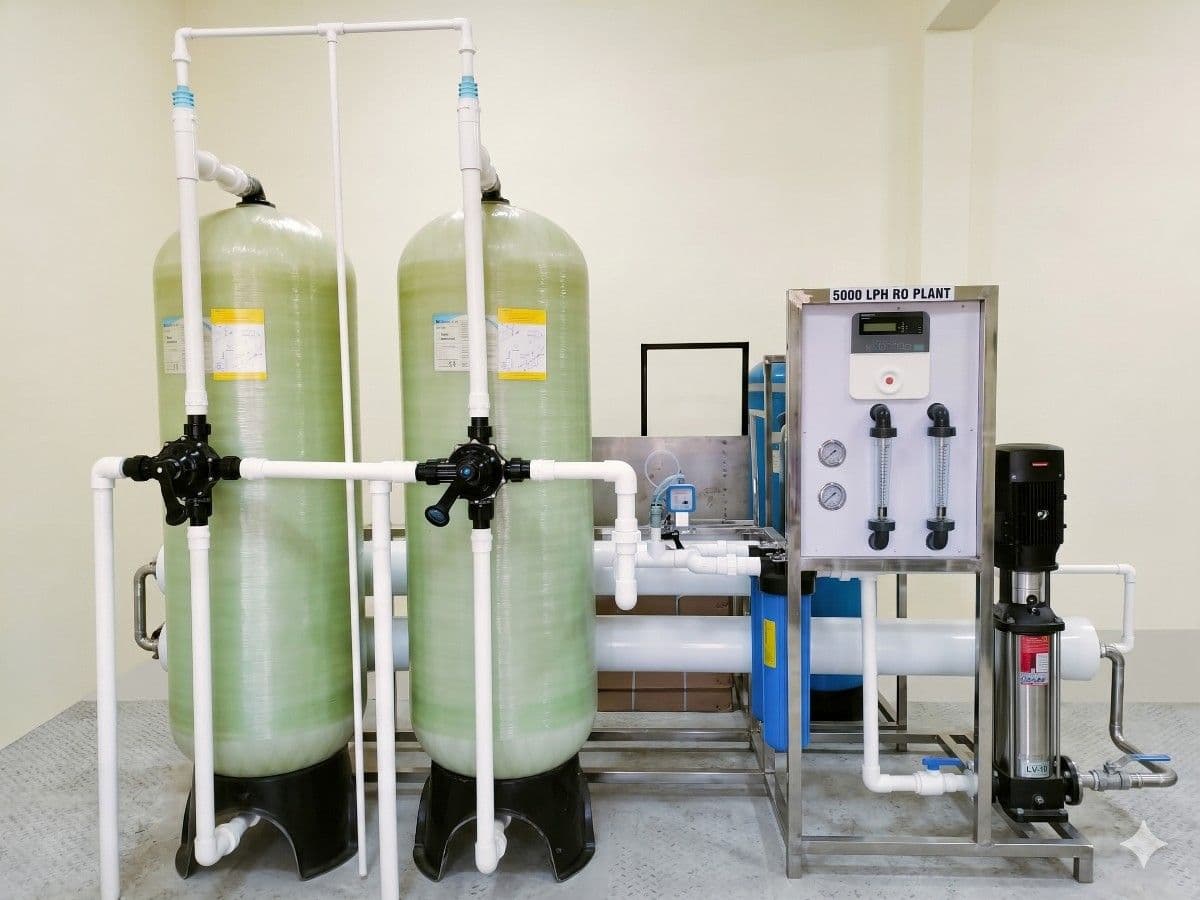
Vessel Type
High Pressure Vessel Array
Control
PLC + Remote IoT
Pumping Power
Dual VMS Stainless Steel
Availability
Mission Critical / 24x7
When a 5000 LPH RO plant is the right choice
A 5000 LPH RO plant represents maximum industrial capacity, serving as the backbone for critical infrastructure, massive manufacturing operations, and large-scale water treatment facilities.
Power plants, large malls, critical manufacturing hubs.
Extensive industrial parks and landmark commercial complexes.
A 5000 LPH RO plant is the ultimate solution for maximum-scale industrial operations where water is the lifeblood of continuous production across extensive facilities that serve thousands of people and multiple critical processes simultaneously.
This capacity powers large power plants, mega shopping malls, extensive industrial parks, major hospitals, and landmark commercial complexes where water demand reaches peak levels during operational hours and reliability is non-negotiable.
Maximum capacity note
Engineered for extreme reliability with redundant systems, advanced automation, comprehensive pretreatment, and industrial-grade construction for continuous duty.
The 5000 LPH RO:Maximum Scale. Zero Compromise.
The 5000 Liters Per Hour (5 m³/hr) plant represents the pinnacle of high-throughput industrial RO technology. Capable of generating an astounding 1,20,000 liters per day, this system is engineered for massive industrial ecosystems where water is the primary operational fuel. Featuring massive 8040 membrane configurations or high-density 4040 arrays, it delivers unwavering purity for the most demanding pharmaceutical and manufacturing protocols.
Performance Masterclass
Massive-Scale Output
83.3 L/Min
Industrial velocity for massive reservoirs
Peak OPEX
Maximum power-to-permeate efficiency
Industrial
Multi-membrane bank for ultra-stability
The 5 m³/hr Strategic Standard
At this scale, every percentage of recovery matters. Our 5000 LPH plant utilizes staged filtration logic that minimizes brine waste while maximizing permeate volume, making it the most environmentally and fiscally responsible choice for massive operations.
Structural Monolith
Reinforced with a heavy-duty SS-316/304 structural skid. Engineered specifically to dampen the massive hydraulic forces of a 5000 LPH flow rate.
Absolute Economy
Leverages extreme economies of scale. Achieves the industry's lowest total cost of ownership (TCO) through high-efficiency motor-pump synchronization.
Autonomous Logic
Features high-end PLC controllers with HMI touch interfaces. Capable of unattended 24/7 operation with automatic emergency failsafes.
Utility Longevity
Designed with modular accessibility. Components are arranged to allow for rapid maintenance without needing to dismantle the entire plant.
Who should buy a 5000 LPH RO plant
A 5000 LPH RO plant is built for facilities where water treatment is part of mission-critical infrastructure, not just site support. It suits organizations that need very high purified-water output, round-the-clock dependability, and one large system capable of feeding multiple high-demand applications at the same time. [web:113][web:117][web:121][web:125]
Pharma Companies, Dialysis & High-Purity Healthcare Utilities
An ideal choice for pharma companies, dialysis support systems, and healthcare-grade utility networks that need high-volume purified water for product-related operations, equipment cleaning, sterile workflows, and patient-care-linked infrastructure.
Food Processing, Beverage Plants & Syrup Production
Well-suited for food factories, beverage processing lines, and fruit syrup production units that require very high treated-water availability for ingredient preparation, plant hygiene, equipment washing, and continuous manufacturing output.
Boiler Feed, Power Utilities & Heavy Technical Operations
A strong match for boiler-feed systems, power-related utilities, and technical operations where water quality, scale control, and continuous feed reliability are essential to protect equipment and maintain stable performance.
Institutional Parks, Pharma Clusters & Multi-Use Campuses
Best for large institutional parks, pharma processing clusters, and mixed-use industrial campuses where one centralized RO plant is expected to support several units, departments, or production zones from a common water strategy.
Capacity Fit
Why 5000 LPH is a strategic water backbone
The 5000 LPH category is consistently presented as a very high-capacity industrial RO solution. Current references specifically mention pharmaceutical industries, food processing, dialysis, boiler feed, hospitals, laboratories, breweries, textile industries, and chemical industries, which shows that this size is selected where both purity and large volume are operationally indispensable. [web:111][web:114][web:115][web:120][web:121][web:124]
5000 LPH
Very high hourly flow for enterprise-scale treatment
Round-the-Clock Ready
Built for nonstop industrial and utility-heavy schedules
Critical Infrastructure
Best where one plant must support many water-dependent operations
Best-buy profile
Choose a 5000 LPH RO plant when your facility needs a centralized, high-capacity purified-water backbone, especially for pharma companies, dialysis-linked healthcare systems, food and beverage plants, boiler-feed networks, or large industrial campuses with nonstop demand. [web:111][web:115][web:119][web:121][web:124]
Best for facilities where water treatment directly supports regulated or equipment-sensitive operations.
Ideal where one RO system must feed healthcare, production, utility, and service functions together.
A strong upgrade path for enterprises stepping beyond 4000 LPH into mission-critical water infrastructure.
Estimated daily water production
A 5000 LPH system is a heavy-duty industrial plant designed for maximum throughput. This capacity supports large-scale manufacturing and municipal needs, utilizing high-pressure vertical multistage pumps and extensive membrane arrays for consistent 5 $m^3/h$ delivery.
Runtime
8 Hours
40,000 Liters
Runtime
12 Hours
60,000 Liters
Runtime
20 Hours
100,000 Liters
5000 LPH RO plant specifications
Engineered for reliable purification performance with high output capacity, durable components, and practical installation requirements.
System overview
Technical configuration at a glance
What affects 5000 LPH RO plant price?
In the 5000 LPH segment, price is usually shaped by project criticality. A plant built for hospitals, packaged drinking water, pharma, boiler feed or other high-dependency use cases will often require stronger controls, more reliable materials, deeper pretreatment and more robust system architecture than a basic installation.
- Whether the project is for packaged drinking water, industrial utility, boiler feed, healthcare, pharma or beverage production.
- FRP versus SUS304/SUS316 stainless-steel construction and the overall project-grade material specification.
- PLC or standard panel control, automation level, online displays, flushing logic and monitoring sophistication.
- Pretreatment scope, such as UV, iron removal, softener, micron filtration and source-water correction systems.
- Membrane count, pump sizing, recovery expectations and the need to support long daily or critical-duty operation.
Indicative pricing
₹3.50 Lakh – ₹7.26 Lakh+*
Public references show 5000 LPH examples around ₹3.5 lakh, ₹4.90 lakh, ₹4.95 lakh, ₹5 lakh and ₹7.26 lakh, with some marketplace listings showing wider outliers depending on specification and listing quality.
*Indicative only. Final pricing depends on structure material, controls, pretreatment scope, application type, runtime expectation and installation complexity.
Get Instant QuoteAt 5000 LPH, source water planning is a critical financial lever
In major-capacity plants, unstable raw water accelerates membrane fouling and reject loss exponentially. At this volume, proactive pretreatment and source correction aren't just technical safeguards—they are essential to protecting both your operational uptime and the core project economics.
Common 5000 LPH customization paths
- FRP economy versions versus SUS304/SUS316 project-grade stainless-steel builds.
- PLC controls, auto-flushing logic, and enhanced industrial protection features.
- Integrated UV, iron removal, and advanced softeners for difficult raw water profiles.
- Tailored packages for Packaged-Water, Healthcare, Pharma, and Boiler applications.
- Long-duty project planning for high-consequence sites requiring absolute reliability.
Questions to answer before specifying 5000 LPH
A 5000 LPH decision should be treated as a strategic infrastructure decision. The buyer should know exactly how the system will support the site, what happens if it goes down and what treatment reliability is truly required.
Is the plant intended for industrial utilities, packaged water, pharma, healthcare, boiler feed or a large centralized commercial site?
Will water interruption directly affect production, healthcare delivery, packaged-water output or another mission-critical function?
Do you require FRP cost-efficiency or a project-grade SUS304/SUS316 stainless-steel installation?
Do you have a full raw water analysis covering TDS, hardness, iron, silica, turbidity and source consistency?
Will the plant operate in long daily cycles, high-throughput shifts or critical round-the-day service windows?
Is 5000 LPH the right long-term capacity, or is the project likely to require an even larger system soon?
5000 LPH value is determined by reliability, not only by purchase price
In this segment, the real value of the system comes from stable output, low interruption risk, strong pretreatment, durable controls and how well the plant supports critical functions over time. Lowest initial price rarely tells the full project story.
Maintenance consequences
At 5000 LPH, unplanned maintenance or weak service planning can affect large daily demand and create wider operational disruption.
Operational efficiency
Pump sizing, recovery logic, membrane protection and pretreatment quality heavily influence long‑term cost and uptime.
Infrastructure resilience
This capacity creates value when the system remains dependable under heavy daily demand and critical service conditions.
Is 5000 LPH the right mission‑critical threshold?
Compare 5000 LPH with adjacent capacities to decide whether you need a major utility‑grade plant or a much larger enterprise‑scale treatment installation.
| Capacity | Best For | Daily Output | Price Direction |
|---|---|---|---|
| 4000 LPH | Multi-industry utility and production support | 32,000–40,000 L/day* | Lower than 5000 LPH |
| 5000 LPH | Mission-critical industrial and utility infrastructure | 40,000–50,000 L/day* | ₹3.5 lakh – ₹7.26 lakh+* |
| 10000 LPH | Very large industrial and enterprise-scale treatment demand | 80,000–100,000 L/day* | Substantially higher project range |
Common questions about 5000 LPH RO plant pricing
What is the price of a 5000 LPH RO plant?
Who should choose a 5000 LPH RO plant?
How much water can a 5000 LPH RO plant produce per day?
Is 5000 LPH suitable for packaged drinking water and beverage projects?
Can a 5000 LPH plant be used for boiler feed, dialysis and pharma-related applications?
Are stainless-steel and PLC options common in 5000 LPH systems?
Why is 5000 LPH considered a major infrastructure threshold?
What upgrades are commonly added to 5000 LPH plants?
Explore other RO plant capacities
Compare RO plant pricing pages across all capacity ranges in one clean view.
Need a final 5000 LPH RO plant quotation?
Share your process type, raw water report, runtime expectation, application details and treated‑water demand to get the right 5000 LPH configuration with accurate pricing and throughput‑focused planning.