High-Performance 500 LPH RO Plant Pricing, Specs & Installation
Engineered for hospitals, large restaurants, housing societies, and medium industries, our 500 LPH RO plant provides high-volume purification with heavy-duty durability and advanced filtration stages for consistent water quality.
Ideal Use
Large Commercial
Output
Up to 5,000 L/day*
Best For
Hospital / Factory / Hotel
500 LPH RO Plant
Industrial water treatment system
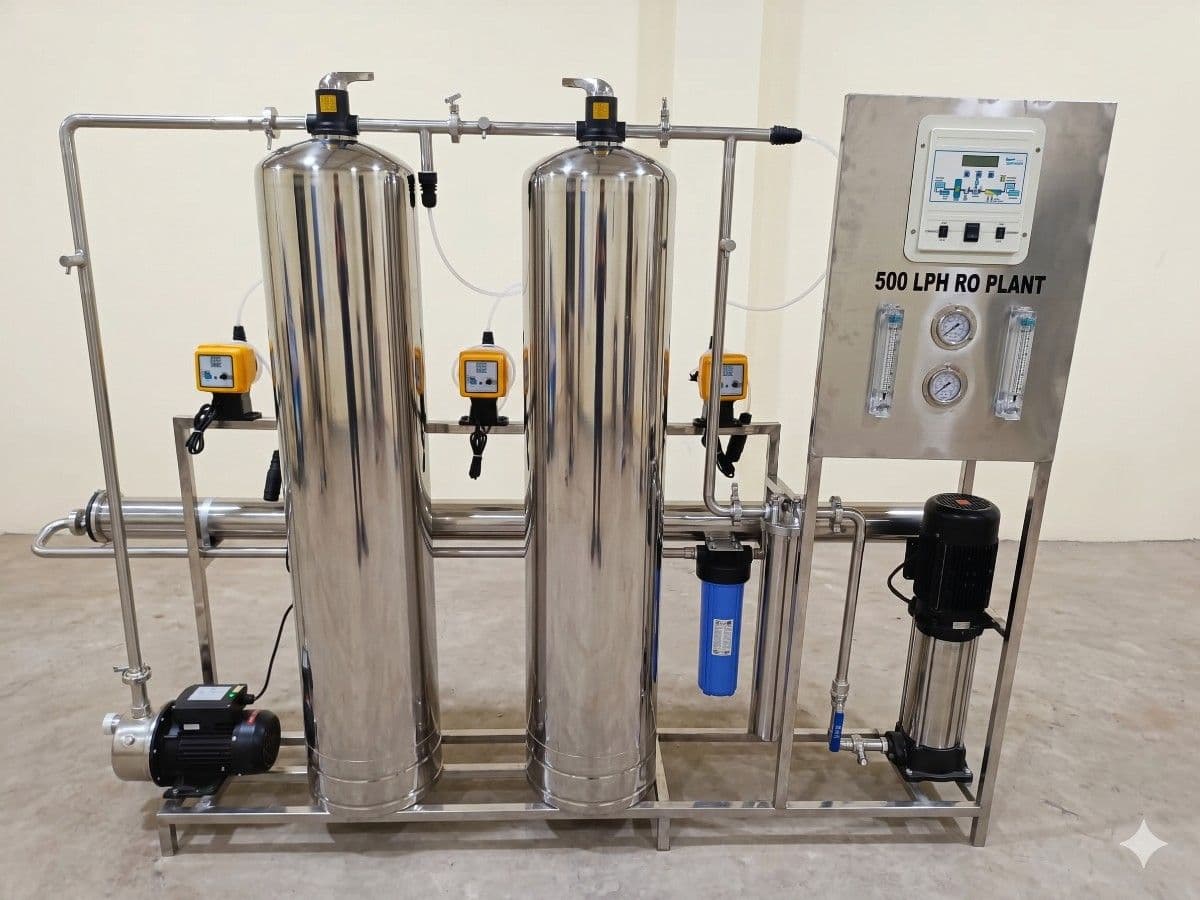
Water Load
Heavy Demand Ready
Operation
Fully Automatic
Membrane
BW-4040 Series
Cycle
Continuous Operation
When a 500 LPH RO plant is the right choice
A 500 LPH RO plant is ideal for businesses and institutions that need a steady, centralized water supply for a larger number of users throughout the day.
Strong fit for schools, hospitals, hostels, offices and commercial facilities.
Designed for continuous demand where many people rely on the same water source.
A 500 LPH RO plant is suitable when water demand is consistently higher and the site needs a reliable plant that can support more people than a 250 LPH system. It is often selected for environments where water consumption is spread across multiple hours and the plant must maintain stable output for daily operations.
This capacity is commonly chosen for schools, colleges, hospitals, hotels, corporate offices, hostels and factories where central water treatment is more practical than multiple smaller purification units.
Useful planning note
For larger user counts, it is better to plan storage, pipeline distribution and service access alongside plant capacity for smoother daily performance.
The 500 LPH RO:Powering semi-industrial growth
Stepping up to 500 Liters Per Hour is a strategic move for businesses with critical water dependencies. This capacity is designed for heavy-duty daily cycles, providing up to 4,000–5,000 liters of purified water per day. It’s the preferred choice for food processing units, mid-sized hotels, dialysis centers, and manufacturing plants.
Engineering Specs
Heavy-Duty Delivery
8.3 L/Min
Fast enough for direct-use applications
5+ Years
Built with SS-304/316 skids for longevity
Auto-Flush
Smart automation to protect membranes
The 500 LPH Competitive Advantage
While 250 LPH plants are great for drinking water, the 500 LPH system is a workhorse for process water. It provides double the output with only a 30% increase in physical footprint, maximizing your space-to-production ratio.
Industrial Resilience
Features high-pressure vertical multistage pumps and larger 4040 membranes designed to handle varied TDS levels without constant clogging.
Scaling Economy
The 500 LPH unit offers the lowest "Initial Cost vs. Water Output" ratio, making it the most affordable entry point for industrial-scale water needs.
Precision Filtration
Equipped with advanced multi-port valves and pre-filtration stages that ensure the water quality meets stringent ISO and industry standards.
Custom Integration
Can be integrated with UV sterilizers, Ozone generators, or Softeners depending on the specific requirements of your industrial process.
Who should buy a 500 LPH RO plant
A 500 LPH RO plant is built for organizations that have moved beyond light commercial usage and now need a stronger, more scalable purified water backbone. It suits medium-sized facilities where water demand stays active across multiple outlets, departments, or shifts through the day. [web:11][web:18][web:23]
Hospitals & Multi-Specialty Clinics
A strong match for healthcare environments that need a larger daily volume of purified water for staff, patients, utility points, pantry access, and continuous institutional use across multiple floors or wings.
Large Schools, Colleges & Campuses
Well-suited for educational institutions serving a large student base, especially where drinking water, cafeteria operations, hostel blocks, and staff facilities all draw from the same purification system.
Hotels, Restaurants & Catering Units
Ideal for hospitality and food-service businesses that need dependable purified water for kitchens, guest-facing use, beverage preparation, washing support, and high-turnover daily service environments.
Food Units, Pharmaceuticals & Small Manufacturing
A dependable choice for packaged food operations, pharmaceuticals companies, and small industrial setups that need higher daily purified water availability for people, process support, or controlled utility usage.
Capacity Fit
Why 500 LPH is a smart upgrade
The 500 LPH category is often the sweet spot for growing facilities. It delivers enough production to support medium-to-high daily consumption while remaining easier to integrate and manage than larger industrial RO installations. [web:11][web:19][web:23]
500 LPH
Built for broader hourly demand coverage
Up to 12,000 L/day
Commonly marketed around full-day commercial runtime
Growth Ready
Good for operations expanding beyond small commercial loads
Best-buy profile
Choose a 500 LPH RO plant when your site has moved past basic water demand and now needs a stronger centralized purification system for multiple users, longer operating hours, and more serious daily load. [web:11][web:18][web:20]
Best for institutions and businesses with medium-scale continuous water usage.
Suitable where multiple departments, kitchens, outlets, or staff blocks depend on one plant.
A natural step-up for buyers scaling from 250 LPH into higher daily service demand.
Estimated daily water production
A 500 LPH system is designed for high-capacity daily consumption. Actual production varies based on duty cycles, membrane health, and the Total Dissolved Solids (TDS) of your source water.
Runtime
8 Hours
4,000 Liters
Runtime
12 Hours
6,000 Liters
Runtime
20 Hours
10,000 Liters
500 LPH RO plant specifications
Engineered for reliable purification performance with higher output capacity, durable components, and practical installation requirements.
System overview
Technical configuration at a glance
What affects 500 LPH RO plant price?
A 500 LPH RO plant price reflects a more demanding use-case than smaller systems. Buyers are paying not only for output, but also for stronger build quality, longer duty cycles, better automation and the ability to support centralized consumption.
- Raw water source, TDS level, hardness and whether additional pretreatment is required.
- Membrane size, pressure pump selection and whether the build is standard or premium-duty.
- Level of automation, TDS monitor integration and electrical panel quality.
- Skid material, vessel quality, piping standard and brand of key components.
- Installation complexity, local site conditions, tank integration and after-sales service commitments.
Indicative pricing
₹85,000 – ₹1,50,000*
Public listings for 500 LPH plants commonly show pricing in the high five-figure to low six-figure range, with several examples around ₹1.15 lakh and some premium references near ₹1.5 lakh depending on automation, component quality and installation scope.
*Indicative only. Final project cost depends on site conditions, feed water profile, pretreatment requirements, automation package and optional accessories.
Get Instant QuoteAt 500 LPH, source water shapes plant engineering design
In this category, water quality planning is vital as the system must support higher daily demand with consistency. Borewell, mixed-source, and hard-water conditions often require stronger pretreatment than initially assumed to maintain output stability.
Optimized 500 LPH enhancement paths
- Water softener integration for high-hardness feed water sources.
- UV / UF polishing for superior microbiological and particulate safety.
- Antiscalant dosing and automated chemical dosing integration.
- SS skid builds and premium pump upgrades for extended service life.
- Auto flushing, TDS monitoring, and intelligent control logic upgrades.
What to confirm before finalizing a 500 LPH plant
At 500 LPH, capacity selection should be tied to actual occupancy, daily load patterns and future expansion. This helps avoid both under-sizing and overbuilding the system.
How many people or users will consume water daily at peak load?
Is the plant for drinking water only or for kitchen / utility / process use too?
What is your raw water source and current TDS or hardness level?
How many hours per day do you expect the plant to run?
Do you need a fully automatic panel with monitoring features?
Will the plant need to support future load growth within 1–2 years?
Operating economics matter more at 500 LPH
Because 500 LPH systems often support centralized and frequent usage, long‑term performance depends heavily on membrane care, pump efficiency, pretreatment quality and scheduled service discipline.
Preventive maintenance
Consistent servicing becomes more important as runtime and user dependency increase across schools, hospitals and commercial facilities.
Power and efficiency
Published examples vary, but many 500 LPH systems are described around 1.5 to 3.5 kW depending on final pump and automation package.
Reliability under load
A properly configured 500 LPH plant offers better service continuity than trying to manage multiple smaller purifiers across one site.
Is 500 LPH the right midpoint for your site?
Compare this capacity with smaller and larger options before deciding on final plant size.
| Capacity | Best For | Daily Output | Price Direction |
|---|---|---|---|
| 250 LPH | Offices, clinics, low-footfall facilities | 2,000–2,500 L/day* | Lower than 500 LPH |
| 500 LPH | Schools, hospitals, hotels, small industries | 4,000–5,000 L/day* | ₹85,000 – ₹1.50 lakh* |
| 1000 LPH | Factories, larger institutions, process demand | 8,000–10,000 L/day* | Higher project-based range |
Common questions about 500 LPH RO plant pricing
What is the price of a 500 LPH RO plant?
Who should choose 500 LPH instead of 250 LPH?
How much water can a 500 LPH RO plant produce in a day?
Is 500 LPH suitable for schools and hospitals?
What is the power consumption of a 500 LPH RO plant?
Can a 500 LPH RO plant work with borewell water?
Is this capacity enough for a small factory or hotel?
Do you provide AMC and on-site service?
Explore other RO plant capacities
Compare RO plant pricing pages across all capacity ranges in one clean view.
Need a final 500 LPH RO plant quotation?
Share your process type, raw water report, runtime expectation, application details and treated‑water demand to get the right 500 LPH configuration with accurate pricing and throughput‑focused planning.