Industrial 3000 LPH RO Plant: Commercial Power & Scaling
Engineered for maximum scale operations, this 3 Tonne RO system provides a massive 30,000 liters per day output. Perfectly suited for municipal supply projects, mega factories, and beverage production lines requiring continuous high-volume purification.
Ideal Use
Large-Scale Industry
Output
3,000 Liters/Hr
Best For
Distillery / Municipal / Mega-Fab
3000 LPH Plant
Ultra-high volume system
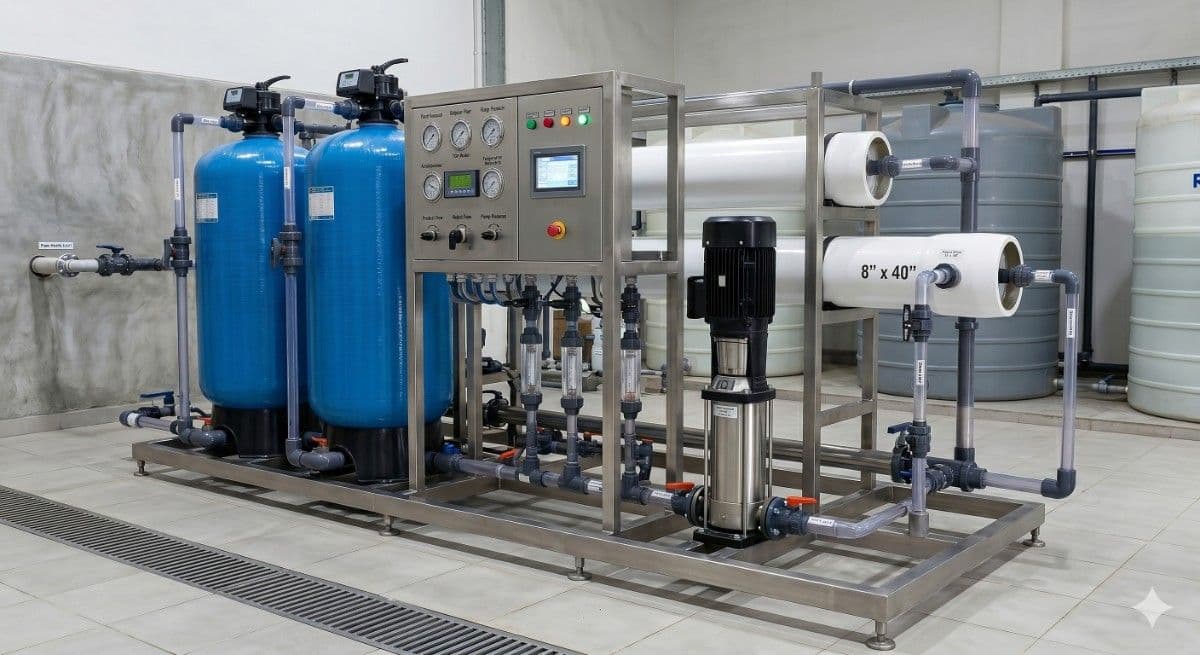
Filtration
Multi-Grade Sand/Carbon
Control
PLC Smart Logic
Pumping
VFD Driven Systems
Duty Cycle
True 24/7 Run-time
When a 3000 LPH RO plant is the right choice
A 3000 LPH RO plant is engineered for mission-critical industrial operations that demand uninterrupted, high-volume purified water for 24/7 production and large-scale manufacturing.
Continuous operation for factories and production facilities.
Water bottling, large-scale food processing and industrial packaging.
A 3000 LPH RO plant is the standard choice for heavy industrial environments where water is a critical input for continuous production processes and large-scale operations that cannot afford interruptions in water supply.
This capacity is essential for water bottling plants, large food and beverage manufacturers, chemical processing facilities, textile factories, power plants, and other industrial operations where high-volume purified water is required around the clock.
Industrial note
Designed for continuous duty with robust construction, advanced controls, and larger pretreatment systems to handle industrial feed water challenges.
The 3000 LPH RO:Unmatched volumetric dominance
The 3000 Liters Per Hour (3 m³/hr) RO plant is engineered for peak-performance industrial ecosystems. Delivering up to 72,000 liters per 24-hour cycle, this massive infrastructure hub provides the high-velocity flow required for industrial-scale boilers, cooling towers, and beverage production lines. It is built for absolute reliability, ensuring that your facility never faces a water-induced production halt.
Utility Engineering
Infrastructure Hub
50 L/Min
Rapid reservoir recovery at scale
Max ROI
Lowest OPEX per cubic meter treated
12x 4040
Massive membrane array for stability
The 3 m³/hr Performance Edge
Designed for extreme duty cycles, our 3000 LPH plant features professional-grade automation that balances inflow and outflow dynamics, ensuring that the RO membranes operate at peak efficiency even under 24/7 load conditions.
Structural Prowess
Reinforced with a heavy-duty SS-304 structural skid, this system is built to manage high-vibration environments typical of large industrial floors.
Operational Alpha
The 3000 LPH scale triggers maximum capital efficiency, providing the lowest energy-to-treated-water ratio in the commercial RO sector.
Advanced PLC/HMI
Full touchscreen control panel with real-time remote monitoring, automatic CIP (Clean-In-Place) logic, and intelligent error diagnostics.
Municipal Strength
Designed to function as a municipal-grade utility. Its modular vessel design allows for membrane maintenance without affecting the total output capacity.
Who should buy a 3000 LPH RO plant
A 3000 LPH RO plant is engineered for operations where purified water demand is heavy, continuous, and closely tied to production or institutional performance. It fits facilities that need a large centralized system capable of sustaining multiple process, utility, and service requirements without interruption. [web:84][web:86][web:90][web:94]
Pharma Companies, GMP Utilities & Water Generation Systems
A premium fit for pharma companies and GMP-oriented water systems that need large volumes of purified water for production support, process preparation, cleaning cycles, utility loops, and pharmaceutical-grade treatment architecture.
Textile, Chemical & Industrial Process Plants
Well-suited for textile units, chemical industries, and process manufacturing plants where large treated-water volumes are needed for repeated industrial stages, process stability, rinsing, and plant-wide utility support.
Breweries, Beverage Plants & Packaged Water Operations
Ideal for breweries, soft drink facilities, and packaged drinking water plants that need constant, large-scale purified water for production lines, ingredient mixing, washing systems, and repetitive shift-based output.
Hospitals, Laboratories & Boiler-Feed Utility Networks
A powerful option for hospitals, laundries, laboratory complexes, and boiler-feed utility setups where high-quality treated water must be available in bulk for mission-critical institutional or technical use.
Capacity Fit
Why 3000 LPH is a high-throughput industrial platform
The 3000 LPH category is consistently described as a large-capacity industrial RO solution. Current sources reference pharma, food processing, textiles, hospitals, laboratories, chemical plants, boiler-feed systems, and other heavy-duty applications, showing that this size is intended for facilities with broad and sustained demand. [web:82][web:84][web:85][web:86][web:89][web:94]
3000 LPH
Massive flow rate for high-load process environments
Long-Shift Ready
Built for continuous industrial and institutional duty
Process Intensive
Best where water quality and volume both drive performance
Best-buy profile
Choose a 3000 LPH RO plant when your operation needs a high-throughput, centralized water platform, especially for pharma companies, chemical plants, beverage factories, hospitals, or utility-heavy industrial sites where output continuity and water quality cannot be compromised. [web:84][web:85][web:89][web:95]
Best for facilities running multiple high-demand process and utility lines together.
Ideal where one plant must support production, compliance, and institutional service needs at scale.
A strong next step for enterprises moving beyond 2500 LPH into a heavier industrial capacity band.
Estimated daily water production
A 3000 LPH system is designed for high-demand industrial utility. Performance is maximized through advanced multi-membrane housing and automated flux control, ensuring stable delivery at high volumes.
Runtime
8 Hours
24,000 Liters
Runtime
12 Hours
36,000 Liters
Runtime
20 Hours
60,000 Liters
3000 LPH RO plant specifications
Engineered for reliable purification performance with high output capacity, durable components, and practical installation requirements.
System overview
Technical configuration at a glance
What affects 3000 LPH RO plant price?
Pricing in the 3000 LPH category is often shaped by project intent. A basic FRP industrial plant, a stainless-steel system, a packaged-water-oriented setup and a utility-focused engineered plant can all carry very different pricing even at the same nominal capacity.
- Whether the plant is positioned for commercial-industrial use, packaged drinking water, boiler support or heavy industrial utility service.
- FRP versus stainless-steel construction, along with skid strength, component durability and corrosion resistance requirements.
- Optional UF, UV, softener, digital display, online monitoring and process-specific accessory packages.
- Membrane count, recovery target, pressure pump selection and expected runtime intensity.
- Raw water challenge level and the degree of pretreatment needed for high-load stable operation.
Indicative pricing
₹1.75 Lakh – ₹4.90 Lakh+*
Public listings for 3000 LPH systems include examples around ₹1.75 lakh, ₹3.10 lakh, ₹3.25 lakh, ₹3.95 lakh, ₹4.25 lakh, ₹4.50 lakh, ₹4.70 lakh and ₹4.90 lakh depending on build class and accessories.
*Indicative only. Final project pricing depends on materials, membranes, UV/UF options, automation, application type and source-water treatment needs.
Get Instant QuoteAt 3000 LPH, source water analysis is a core economic decision
At this scale, unstable feed quality translates directly into higher rejection losses and membrane stress. For high-capacity projects, pretreatment logic and design discipline aren't just technical details—they are foundational to your plant's long-term ROI and operational efficiency.
Common 3000 LPH customization paths
- FRP cost-led configurations versus SS corrosion-resistant industrial builds.
- UV, UF, and advanced accessory packages for packaged water or high-purity needs.
- Custom treatment-line tailoring for Boiler, Pharma, Food, and Dairy sectors.
- Industrial monitoring, digital interfaces, and enhanced automation logic.
- Multi-tank distribution planning and full-site systems integration support.
Questions to answer before specifying 3000 LPH
A 3000 LPH project should be evaluated as a system decision, not only as a capacity decision. The buyer should know how the plant will serve the site, not just how much water it can produce per hour.
Will the plant serve packaged drinking water, boiler feed, utilities, centralized drinking supply or mixed-use demand?
How many downstream tanks, departments or service points will depend on the system?
Do you have a full raw water report including TDS, hardness, silica, iron and turbidity?
Do you need FRP value, stainless-steel durability or a more hygiene-oriented industrial build?
Will the plant run for limited hours, multiple shifts or near-continuous duty?
Is 3000 LPH the long-term capacity target, or is your site likely to outgrow it soon?
3000 LPH buying decisions should be judged as infrastructure investments
At this level, long‑term value is shaped by plant reliability, accessory quality, recovery behavior, serviceability and how well the system supports a larger site’s actual operational pattern. Upfront cost is only one part of the project outcome.
Maintenance planning
A 3000 LPH system should be maintained with utility‑level discipline because downtime at this scale can affect many downstream users or service areas.
Project efficiency
Pretreatment, membrane performance and automation quality influence whether the plant remains efficient under larger daily throughput loads.
Long‑term project fit
This capacity often delivers value when the plant is meant to act as a longer‑term central platform instead of another temporary upgrade step.
Is 3000 LPH the right large‑project threshold?
Compare 3000 LPH with nearby capacities to decide whether your site needs a stronger enterprise‑scale water backbone or an even larger heavy‑utility setup.
| Capacity | Best For | Daily Output | Price Direction |
|---|---|---|---|
| 2500 LPH | High-output industrial continuity and scale-up | 20,000–25,000 L/day* | Lower than 3000 LPH |
| 3000 LPH | Enterprise-scale distribution and larger projects | 24,000–30,000 L/day* | ₹1.75 lakh – ₹4.90 lakh+* |
| 5000 LPH | Major industrial demand and larger utility networks | 40,000–50,000 L/day* | Higher heavy-project range |
Common questions about 3000 LPH RO plant pricing
What is the price of a 3000 LPH RO plant?
Who should choose a 3000 LPH RO plant?
How much water can a 3000 LPH plant produce per day?
Is 3000 LPH suitable for packaged drinking water projects?
Are FRP and stainless-steel options both available in 3000 LPH?
Can a 3000 LPH RO plant be used for boilers and industrial utilities?
Why is 3000 LPH considered a larger project threshold?
What upgrades are common in a 3000 LPH system?
Explore other RO plant capacities
Compare RO plant pricing pages across all capacity ranges in one clean view.
Need a final 3000 LPH RO plant quotation?
Share your process type, raw water report, runtime expectation, application details and treated‑water demand to get the right 3000 LPH configuration with accurate pricing and throughput‑focused planning.