Heavy-Duty 2500 LPH RO Plant: Commercial Output & Specs
Our 2.5 Tonne system is a powerhouse designed for massive industrial parks, chemical processing units, and large-scale agricultural projects. Featuring reinforced filtration stages and dual-pumping logic to maintain high flow rates even under demanding water conditions.
Ideal Use
Enterprise / Agriculture
Output
2,500 Liters/Hr
Best For
Chemical / Agri / Bottling
2500 LPH RO Plant
Mass-volume treatment system
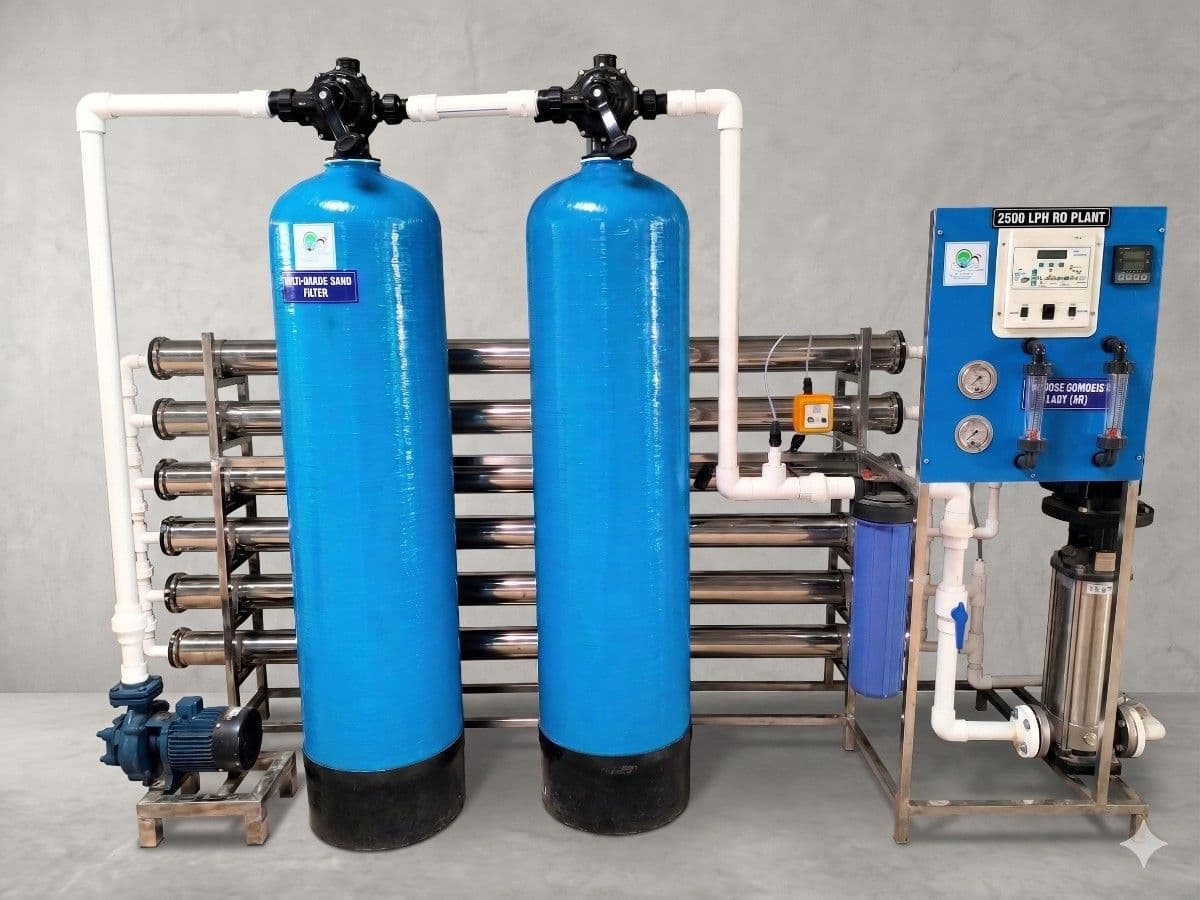
Vessel System
Triple Heavy-Duty FRP
Operational Mode
Fully PLC-HMI Logic
Membrane Array
High Recovery 8040
Performance
Low Maintenance Cycle
When a 2500 LPH RO plant is the right choice
A 2500 LPH RO plant is built for complex operations that demand high-volume purified water for specialized production processes, beverage manufacturing, and pharmaceutical applications.
Beverage production, pharma manufacturing, food processing with strict standards.
High-purity water meeting industry-specific quality requirements.
A 2500 LPH RO plant is the optimal solution for businesses that require substantial volumes of high-purity water for specialized production processes where water quality directly impacts product standards and compliance.
This capacity is widely used in beverage bottling plants, pharmaceutical manufacturing, food processing facilities with strict hygiene requirements, chemical production, and large-scale commercial operations where process water must meet industry regulations.
Compliance note
Water quality testing, certification, and specialized pre-treatment are often required to meet regulatory standards for food, pharma, and beverage production.
The 2500 LPH RO:Unrivaled high‑volume precision
The 2500 Liters Per Hour (2.5 m³/hr) plant is the gold standard for high‑capacity industrial water treatment. Designed to generate up to 60,000 liters per day, this massive utility system serves the largest manufacturing sectors, centralized urban residential schemes, and pharmaceutical production floors. It is engineered for those who cannot afford a single hour of downtime and require the highest volumetric recovery in the industry.
Utility Metrics
Infrastructure Power
41.6 L/Min
High‑velocity output for massive reservoirs
Low Cost/m³
Maximum economy of scale for large usage
10x 4040
Expanded membrane bank for stable purity
Why 2500 LPH is the Enterprise Choice
This system is built for "Constant Flow" environments. With Variable Frequency Drive (VFD) options and automated PLC logic, it adjusts to your facility's demand in real‑time, preventing energy waste while ensuring a steady supply of industrial‑grade water.
Commercial Longevity
Utilizes industrial‑spec Vertical Multistage Pumps with IE3 high‑efficiency motors, ensuring the core mechanics outlast standard commercial alternatives by years.
Financial Mastery
At 2500 LPH, your cost‑per‑liter reaches its lowest possible threshold. This plant is a strategic investment for facilities that view water as a primary utility cost.
Advanced Automation
Equipped with professional PLC panels featuring real‑time analytics, auto‑restart logic, and multi‑parameter safety locks for unattended 24/7 operation.
Skid‑Based Mobility
Despite its massive output, the plant is housed on a compact, vibration‑damped SS skid, allowing for easier site integration and faster commissioning than civil plants.
Who should buy a 2500 LPH RO plant
A 2500 LPH RO plant is designed for facilities where water treatment must operate like core infrastructure. It is best for enterprises that need sustained high-output purification, centralized distribution, and a dependable system capable of supporting large-volume industrial or institutional workflows. [web:71][web:74][web:77]
Pharma Companies, API Units & Process Water Blocks
A strong fit for pharma companies, API manufacturing units, and pharmaceutical process water blocks that require a larger purified water backbone for formulation support, process makeup, equipment washing, and controlled utility operations across long production cycles.
Food & Beverage Plants with Continuous Production
Ideal for beverage factories, packaged water lines, food processing plants, and high-volume production facilities where purified water must remain available continuously for mixing, washing, line support, and sanitation cycles.
Chemical, Specialty Manufacturing & Treatment Utilities
Well-suited for chemical plants, specialty manufacturing units, and centralized treatment utilities that need high-output purified water for process support, utility feed, rinsing stages, and controlled industrial operations.
Large Campuses, Utility Centers & Multi-Block Facilities
A powerful option for industrial campuses, infrastructure-heavy hotels, and centralized utility centers where one RO system must serve multiple buildings, production zones, support blocks, or operational departments.
Capacity Fit
Why 2500 LPH is built for top-end industrial demand
The 2500 LPH segment is consistently marketed as a large-capacity industrial solution. Current listings specifically mention pharmaceuticals, chemical industries, food and beverage production, and manufacturing, which shows that this size is chosen when water treatment must support high-output, enterprise-level operations. [web:71][web:77][web:78][web:81]
2500 LPH
Massive hourly throughput for enterprise-scale operations
Continuous Duty
Best where high-load systems run for long daily cycles
Enterprise Utility
Designed for facilities where water is core infrastructure
Best-buy profile
Choose a 2500 LPH RO plant when your facility needs one powerful centralized purification platform, especially for pharma companies, chemical processing sites, beverage factories, or major industrial campuses where smaller plants create operational bottlenecks. [web:71][web:72][web:77][web:78]
Best for high-output facilities where treated water supports core production or regulated workflows.
Ideal for organizations consolidating multiple demand points into one industrial water system.
A smart step for enterprises moving beyond 2000 LPH into maximum pre-configured capacity.
Estimated daily water production
A 2500 LPH system is built for heavy-duty industrial scale applications. The high-volume flow is maintained through precision-engineered pump pressure and high-surface-area membrane filtration arrays.
Runtime
8 Hours
20,000 Liters
Runtime
12 Hours
30,000 Liters
Runtime
20 Hours
50,000 Liters
2500 LPH RO plant specifications
Engineered for reliable purification performance with high output capacity, durable components, and practical installation requirements.
System overview
Technical configuration at a glance
What affects 2500 LPH RO plant price?
The 2500 LPH category often shows a wider price variation than lower capacities because it spans a large specification range. Buyers may find entry-level FRP systems at one end, while SS, mineral-water or more engineered industrial builds sit far higher on the same capacity label.
- Whether the plant is a lower-cost FRP configuration or a heavier stainless-steel industrial build.
- Membrane count, pressure pump duty, filtration architecture and expected recovery performance.
- Automation package, panel sophistication, sensors, flushing logic and digital monitoring features.
- Application-specific upgrades for food, packaged water, industrial process support or utility continuity.
- Raw water profile, including high TDS, hardness, iron, turbidity and the pretreatment needed to stabilize performance.
Indicative pricing
₹1.45 Lakh – ₹7.00 Lakh*
Public listings for 2500 LPH RO plants range from lower-cost FRP offerings near ₹1.45 lakh to automatic and stainless-steel systems around ₹2.5 lakh to ₹4.75 lakh, with some listings reaching ₹7 lakh for higher-grade configurations.
*Indicative only. Final pricing depends on application, structure material, automation, membrane setup, pretreatment scope and project expectations.
Get Instant QuoteFeed water stability becomes more valuable at 2500 LPH
At this capacity, poor source-water planning can amplify membrane fouling and pressure instability, leading to significant reject losses. Consistent pretreatment and a rigorous design basis are essential to maintaining long-term output and minimizing recurring service expenses.
Customization & Integration
- FRP economy builds versus SS hygiene-oriented premium industrial builds.
- Additional dosing, softening and pretreatment for difficult water conditions.
- Food-grade, mineral water, or process-specific treatment-line customization.
- Auto-flushing, online meters, and improved control panel monitoring.
- Distribution planning for multiple tanks or downstream facility points.
Questions to answer before specifying 2500 LPH
A 2500 LPH buying decision should focus on long‑run continuity, downstream distribution, expansion path and whether the plant must hold stable output across varying operational loads.
Will the plant support centralized utility use, packaged water, food processing or general industrial demand?
What is your actual peak daily requirement during full-load working conditions?
Do you have a detailed raw water report including TDS, hardness, iron, silica and turbidity?
Will the plant operate in long daily cycles or near-continuous industrial conditions?
Do you need FRP economy, stainless-steel durability or a more hygiene-oriented process build?
Is your demand likely to exceed 2500 LPH soon, or is this the right long-term operating window?
2500 LPH buyers should compare lifecycle stability, not only upfront price
In this segment, the most important question is often not “what is the lowest quote,” but “which system will sustain output, protect membranes and stay reliable as demand rises.” Lifecycle stability becomes a major value driver at 2500 LPH.
Maintenance structure
A 2500 LPH plant needs disciplined service planning because small inefficiencies become larger recurring costs at higher throughput.
Operating efficiency
Pump duty, membrane recovery, pretreatment stability and runtime strategy all influence real‑world value and plant consistency.
Scalability value
This capacity is often chosen because it reduces the risk of repeated near‑term upgrades while still staying more manageable than much larger projects.
Is 2500 LPH the right expansion threshold?
Compare 2500 LPH with nearby capacities to decide whether you need a continuity‑focused scale‑up system or a larger enterprise utility plant.
| Capacity | Best For | Daily Output | Price Direction |
|---|---|---|---|
| 2000 LPH | Industrial utility and process-support sites | 16,000–20,000 L/day* | Lower than 2500 LPH |
| 2500 LPH | High-output industrial continuity and expansion | 20,000–25,000 L/day* | ₹1.45 lakh – ₹7.00 lakh* |
| 3000 LPH | Larger production and enterprise utility demand | 24,000–30,000 L/day* | Higher engineered range |
Common questions about 2500 LPH RO plant pricing
What is the price of a 2500 LPH RO plant?
Who should choose a 2500 LPH RO plant?
How much water can a 2500 LPH plant produce per day?
Is 2500 LPH suitable for food, manufacturing or industrial operations?
What materials are common in 2500 LPH RO plants?
Why does 2500 LPH pricing vary so much in the market?
Is 2500 LPH a good fit for expansion planning?
Can 2500 LPH systems support mineral water or packaged water applications?
Explore other RO plant capacities
Compare RO plant pricing pages across all capacity ranges in one clean view.
Need a final 2500 LPH RO plant quotation?
Share your process type, raw water report, runtime expectation, application details and treated‑water demand to get the right 2500 LPH configuration with accurate pricing and throughput‑focused planning.