Commercial 250 LPH RO Plant Price, Features & Installation Support
Built for offices, clinics, schools, cafes and small commercial facilities, our 250 LPH RO plant delivers efficient purification, compact installation and dependable daily output without the cost of an oversized system.
Ideal Use
Small Commercial
Output
Up to 2,500 L/day*
Best For
Office / Clinic / School
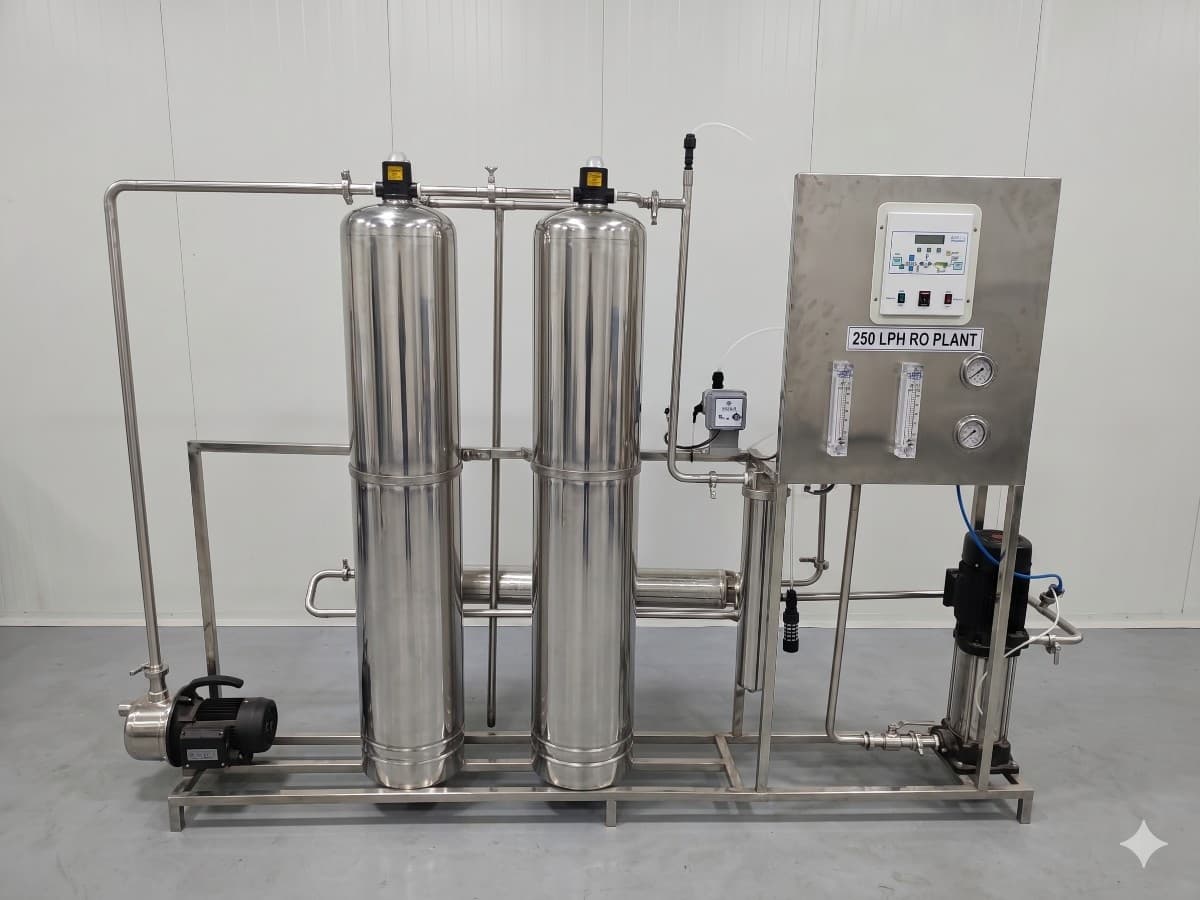
250 LPH RO Plant
Commercial water purification system
Water Demand
Moderate Daily Use
Configuration
Semi / Fully Auto
Build Type
Compact Skid-Mounted
Runtime
8–10 Hrs Typical
When a 250 LPH RO plant is the right choice
A 250 LPH RO plant is a practical option for commercial users who need dependable purified water, moderate daily output, and a compact system that is easier to install and operate than larger industrial units.
A 250 LPH RO plant is best for buyers who need a dependable commercial water purification system but do not require the capital cost, space or operating load of larger units. It is typically a strong fit where demand is moderate, usage is distributed through the day and water is needed mainly for drinking, pantry or light utility applications.
Compared with larger capacities, this size is often chosen by offices, schools, clinics, cafes, hostels and small institutions that want a professional RO setup with better output consistency than domestic systems.
Important note
Actual output depends on runtime, flushing cycles, feed pressure and water quality.
Why the 250 LPH RO isthe smarter choice for your business
The 250 Liters Per Hour capacity bridges the gap between domestic purifiers and heavy industrial plants. It is engineered specifically for establishments that need a continuous flow of pure water without the massive footprint or high power costs of 500+ LPH systems—making it the gold standard for cafés, clinics, schools, and small offices.
Performance Metrics
Balanced Productivity
2000L/Day
Ideal for 8-10 hours of daily operation
Low OPEX
Minimal maintenance vs industrial scale
Plug & Play
Fits in standard utility rooms
Why this capacity outperforms others
Unlike 50 LPH units that struggle with demand, or 1000 LPH plants that waste energy on partial loads, the 250 LPH system provides a steady 4-liter-per-minute flow that perfectly matches the peak hours of a growing business.
Tailored For Usage
Purpose-built for moderate water demand. It avoids the overkill of industrial machinery while offering 5x the durability of domestic components.
Cost Transparency
Our 250 LPH pricing includes realistic maintenance forecasts and installation scopes, ensuring no hidden costs post-purchase.
Modular Design
The skid-based 250 LPH frame is designed to be accessible. It allows for easy filter swaps and can be integrated with existing storage tanks effortlessly.
Rapid Installation
Unlike larger plants that take days to calibrate, our 250 LPH system is pre-configured for quick deployment, minimizing downtime for your facility.
Who should buy a 250 LPH RO plant
A 250 LPH RO plant is ideal for sites that need a dependable flow of purified water through the day without stepping into oversized industrial infrastructure. It fits operations where daily consumption is serious, water quality matters, and uptime is essential for routine service, production, or public use.
Small Hospitals & Clinics
Well-suited for medical spaces that require a steady supply of treated water for washing, utility usage, process support, and dependable daily operations across multiple departments.
Schools, Colleges & Hostels
A strong fit for campuses and residential education facilities where purified water is needed continuously for students, kitchen areas, staff blocks, and shared access points.
Hotels, Guest Houses & Resorts
Ideal for hospitality properties that want in-house purified water for guest usage, kitchen operations, staff service areas, and a more controlled water experience.
Pharmaceuticals & Small Industries
Suitable for light industrial and process-oriented units that need purified water for production support, workforce use, washing stages, or controlled utility applications.
Capacity Fit
Why 250 LPH works so well
The 250 LPH segment sits in a highly practical zone: large enough to handle continuous daily usage, yet compact enough to install, maintain, and operate without the complexity of a much bigger industrial plant.
250 LPH
Stable hourly production for medium daily demand
Long Duty
Built for regular operational cycles through the day
Efficient Capex
Better fit where demand is real but not industrial-scale
Best-buy profile
Choose a 250 LPH RO plant when your site needs dependable purified water every day, but you still want compact footprint, manageable maintenance, and a premium commercial-grade setup instead of a heavy industrial installation.
Ideal for properties serving people continuously through the day.
Strong fit where water purity directly impacts service quality or operational reliability.
Premium option for buyers moving up from small commercial systems.
Estimated daily water production
A 250 LPH system is usually selected based on daily consumption planning. Actual production depends on runtime, flushing loss, membrane efficiency, and incoming feed water quality.
Runtime
8 Hours
≈ 2,000 Liters/Day
Runtime
10 Hours
≈ 2,500 Liters/Day
Runtime
12 Hours
≈ 3,000 Liters/Day*
250 LPH RO plant specifications
Engineered for reliable purification performance with balanced operating efficiency, durable components, and practical installation requirements.
System overview
Technical configuration at a glance
What affects 250 LPH RO plant price?
A 250 LPH RO plant price is not fixed by capacity alone. It changes with water quality, treatment complexity, component quality, operating expectations and installation scope.
- Feed water TDS, hardness and source such as borewell, municipal or mixed water.
- Membrane quality and whether the system uses standard or premium branded components.
- Pump brand, frame material and control panel automation level.
- Optional stages such as UV, UF, softener, antiscalant dosing or ozone integration.
- Installation scope, storage tank requirements, piping distance and service expectations.
Indicative pricing
₹65,000 – ₹1,10,000*
Market listings for 250 LPH systems show broad variation, with examples around ₹65,000, ₹76,000, ₹80,000 and higher premium listings above ₹1 lakh depending on automation, build quality and accessories.
*Use this as a directional guide, not a final quotation. Final pricing depends on water report, pretreatment, material, automation and installation scope.
Get Instant QuoteRaw water conditions directly impact longevity
If your feed water comes from borewell or mixed sources, you may need additional pretreatment to control hardness, iron, or scaling potential. High-quality pretreatment protects membrane life and helps keep your total ownership costs under control.
Optimized system enhancements
- UV disinfection for added microbiological protection.
- UF stage for better suspended solids control and clarity.
- Water softener integration for high-hardness borewell sources.
- Antiscalant dosing systems for maximum membrane protection.
- SS skid upgrades for premium build quality and industrial durability.
Before asking for a final 250 LPH price
The more accurate your input data, the more accurate your plant recommendation and quotation will be. This reduces the chance of under-sizing, overspending, or selecting the wrong pretreatment configuration.
What is your feed water source — borewell, municipal or tanker water?
Do you know the raw water TDS, hardness and iron content?
How many liters per day do you need during peak usage?
Is the plant mainly for drinking water or process use as well?
Do you need UV, UF, softener or storage tank integration?
Do you want semi-automatic or fully automatic control?
Maintenance, uptime and operating cost
Buying a 250 LPH plant is not only about upfront price. Long-term value depends on membrane life, pretreatment quality, service discipline and how efficiently the plant handles your raw water profile.
Routine maintenance
Micron filters, media servicing, periodic inspection and membrane performance checks are part of normal upkeep.
Energy awareness
Pump quality and feed conditions influence power consumption, so low upfront cost should not be the only buying factor.
Consistent uptime
Well-matched pretreatment and scheduled service reduce membrane stress, downtime and emergency repair needs.
Is 250 LPH enough for your requirement?
If your expected daily requirement is increasing, compare nearby capacities before placing the final order.
| Capacity | Best For | Daily Output | Price Direction |
|---|---|---|---|
| 250 LPH | Offices, clinics, schools, hostels | 2,000–2,500 L/day* | ₹65,000 – ₹1.10 lakh* |
| 500 LPH | Schools, small hospitals, medium offices | 4,000–5,000 L/day* | Higher than 250 LPH depending on build |
| 1000 LPH | Factories, hospitals, larger institutions | 8,000–10,000 L/day* | Project-based quotation |
Common questions about 250 LPH RO plant pricing
What is the price of a 250 LPH RO plant?
Who should buy a 250 LPH RO plant?
How much water can a 250 LPH plant produce per day?
Can this plant handle borewell water?
What is the electricity consumption of a 250 LPH RO plant?
What maintenance is required?
Can I upgrade from 250 LPH to 500 LPH later?
Is AMC available for this system?
Explore other RO plant capacities
Compare RO plant pricing pages across all capacity ranges in one clean view.
Need a final 250 LPH RO plant quotation?
Share your process type, raw water report, runtime expectation, application details and treated‑water demand to get the right 250 LPH configuration with accurate pricing and throughput‑focused planning.