Premium 2000 LPH RO Plant: Commercial Power & Efficiency
Engineered for maximum throughput, our 2000 LPH (2 Tonne) system is the benchmark for industrial water security. Ideal for massive pharmaceutical labs, beverage bottling lines, and large-scale construction projects requiring continuous, high-purity water flow.
Ideal Use
Mega Industrial
Output
2,000 Liters/Hr
Best For
Pharma / Beverages / Labs
2000 LPH RO System
Flagship industrial solution
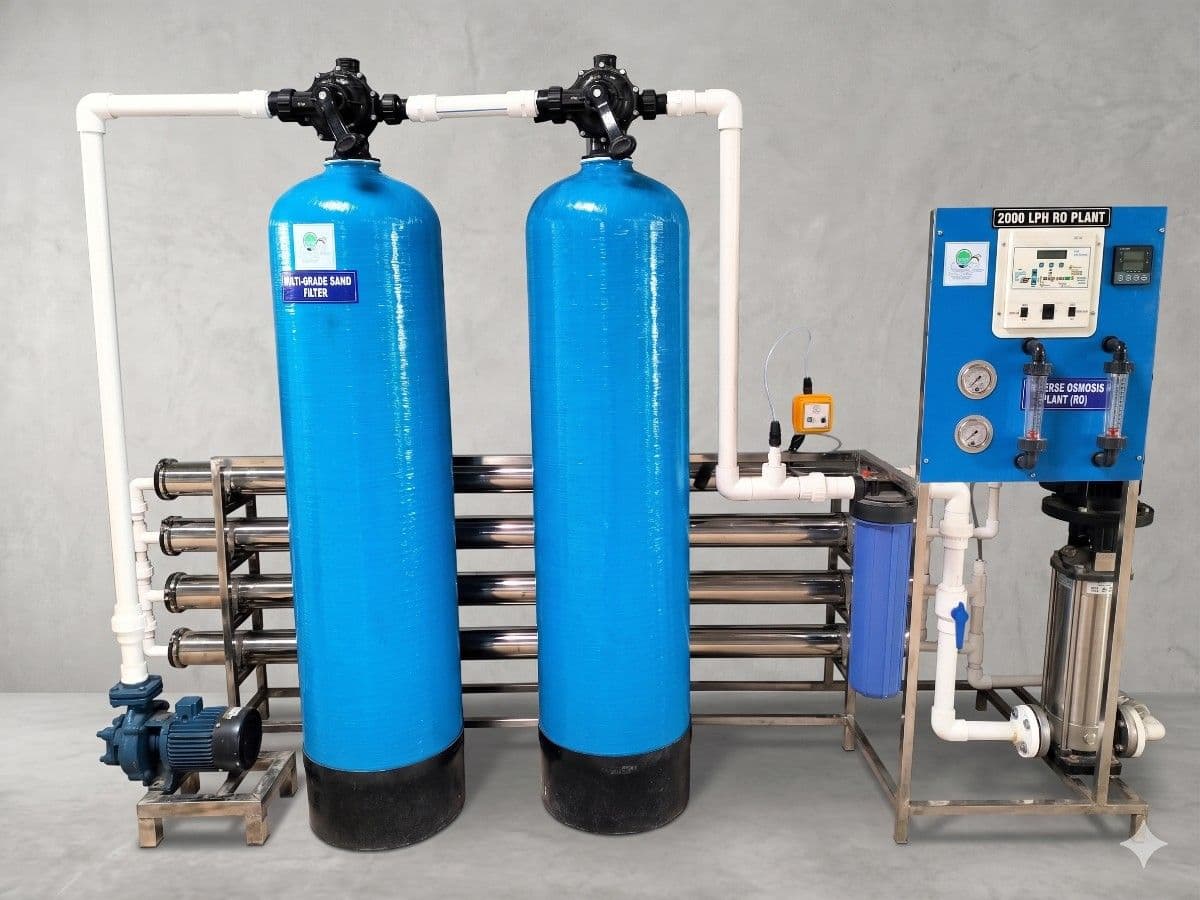
Membrane Spec
High TDS 8040 Range
Control Logic
Advanced PLC + HMI
Frame
Reinforced SS Chassis
Runtime
Continuous 24hr Feed
When a 2000 LPH RO plant is the right choice
A 2000 LPH RO plant is engineered for demanding environments that need a powerful, centralized water supply across multiple buildings, production lines, or facility zones.
Centralized water for large campuses, factories and multi-building complexes.
Supports multiple manufacturing lines and continuous 24/7 operation.
A 2000 LPH RO plant is ideal for large-scale operations that require substantial volumes of purified water distributed across multiple areas or used in intensive production processes. It provides the capacity and reliability needed for sites where downtime must be minimized.
This capacity is frequently chosen for manufacturing factories, food and beverage processing plants, large hotels with multiple restaurants, pharmaceutical facilities, and expansive campuses that need centralized water treatment for drinking, process water, and utility applications.
Infrastructure note
Requires dedicated space, reinforced mounting, power infrastructure and pipeline distribution system to handle the larger water volume and continuous operation.
The 2000 LPH RO:The ultimate industrial workhorse
The 2000 Liters Per Hour (2 m³/hr) plant is the pinnacle of pre‑configured industrial RO systems. Capable of delivering an incredible 40,000 to 48,000 liters per day, this plant is engineered for massive institutional demands. Whether it’s supplying an entire residential township, fueling a large‑scale beverage line, or serving as a centralized hub for a hospital campus, this system offers the highest level of volumetric efficiency possible.
Peak Engineering
High‑Volume Mastery
33.3 L/Min
Massive flow for high‑speed filling
Peak Value
Lowest operational cost per cubic meter
8x 4040
Multi‑vessel array for extreme TDS loads
The 2000 LPH Standard
At this scale, efficiency is everything. Our 2000 LPH plant utilizes advanced rejected water recovery systems and low‑energy membranes to ensure that your utility costs remain as lean as possible while your output remains at the maximum.
Industrial Mastery
Reinforced with dual‑vessel sand and carbon filters, this plant is designed to handle high turbidity and raw water variability without compromising membrane health.
Maximum Economy
Achieve the lowest possible OPEX. The 2000 LPH scale allows for industrial‑sized antiscalant dosing and smart‑flush, extending membrane life by up to 40%.
Next‑Gen Control
Features a fully integrated PLC with touch‑screen HMI options, allowing for precise control over every parameter, from input pressure to output purity levels.
Township Utility
Designed for non‑stop service. The modular nature allows for quick membrane replacement and pump servicing without shutting down the entire facility's supply.
Who should buy a 2000 LPH RO plant
A 2000 LPH RO plant is meant for organizations that need a true infrastructure-grade purification system. It fits medium-to-large industrial and institutional environments where daily treated-water demand is high, multiple process points must run together, and uptime has direct operational value. [web:59][web:60][web:64][web:66]
Pharma Companies & Pharmaceutical Water Systems
A strong choice for pharma companies and pharmaceutical support systems that need high-volume purified water for production zones, utility loops, process preparation, washing lines, and tightly controlled plant operations.
Food, Beverage & Packaged Water Facilities
Ideal for food processing, beverage units, bottling lines, and packaged water operations that need substantial treated-water flow for continuous production, cleaning cycles, and quality-sensitive output.
Hospitals, Medical Utilities & Institutional Labs
Well-suited for large hospitals, healthcare campuses, and lab-centric institutions that need centralized purified water for utility use, sterile support, washing systems, and multi-department distribution.
Manufacturing Campuses, Hotels & Utility Networks
A dependable option for larger hotels, industrial campuses, and centralized utility installations where one high-capacity RO system must serve several departments, blocks, or operational zones through the day.
Capacity Fit
Why 2000 LPH is an enterprise-grade choice
The 2000 LPH category is commonly presented as an industrial or high-end institutional solution. Marketplace and manufacturer listings specifically reference pharmaceutical, hospital, beverage, and manufacturing use cases, reflecting the fact that this capacity is chosen where water treatment becomes a core operational system rather than a support accessory. [web:56][web:57][web:61][web:63][web:66]
2000 LPH
High-throughput capacity for major daily load
Up to 48,000 L/day
Often cited for full-runtime commercial-industrial operation
Mission Critical
Best where uptime and purity directly affect operations
Best-buy profile
Choose a 2000 LPH RO plant when your facility needs enterprise-level purified water output, especially for pharma companies, production plants, hospitals, or large institutional networks where centralized, high-volume treatment is essential to daily performance. [web:56][web:59][web:61][web:66]
Best for sites where purified water supports production, compliance, or large-scale service delivery.
Ideal for facilities running multiple departments, lines, or utility points from one system.
A logical upgrade for buyers moving from 1500 LPH into a larger industrial capacity band.
Estimated daily water production
A 2000 LPH system provides high-volume purification for industrial plants and large facilities. Total daily yield is optimized through multi-stage filtration and high-pressure membrane performance.
Runtime
8 Hours
16,000 Liters
Runtime
12 Hours
24,000 Liters
Runtime
20 Hours
40,000 Liters
2000 LPH RO plant specifications
Engineered for reliable purification performance with high output capacity, durable components, and practical installation requirements.
System overview
Technical configuration at a glance
What affects 2000 LPH RO plant price?
In the 2000 LPH segment, pricing becomes strongly tied to engineering decisions. Two plants with the same nominal capacity can differ sharply in cost depending on whether they are meant for standard commercial service, industrial utility duty or process-critical performance.
- Whether the plant is designed for general commercial use, industrial utility service or process-critical operation.
- Pretreatment scope, including softener, iron removal, antiscalant dosing, micron stages and source-water correction.
- Material of construction, such as FRP versus stainless-steel skid, vessel and piping choices.
- Automation sophistication, protection logic, TDS monitoring, flushing system and panel configuration.
- Application-specific customization for boiler feed, pharma support, food processing, hospitality or industrial reuse.
Indicative pricing
₹1.70 Lakh – ₹2.95 Lakh+*
Public references for 2000 LPH systems include examples around ₹1.70 lakh, ₹2.66 lakh, ₹2.89 lakh and ₹2.94 lakh, with pricing changing further for stainless-steel builds, higher automation and more specialized treatment stages.
*Indicative only. Final quotation depends on raw water chemistry, structure material, membranes, pretreatment, panel design, accessories and intended application.
Get Instant QuoteRaw water variation has a bigger cost impact here
In a 2000 LPH setup, chemical imbalances can lead to expensive downtime. High levels of silica, iron, or scale potential can drastically reduce membrane life and increase power consumption if the pretreatment isn't engineered specifically for your site's water profile.
Common 2000 LPH customization paths
- Softener, iron-removal or dosing systems for complex source water.
- UV, UF or polishing arrangements for stricter clinical or process targets.
- SS skid and industrial instrumentation for high-demand environments.
- Auto flushing, reject management and recovery optimization modules.
- Boiler feed, pharma support or process-specific treatment tailoring.
Questions to answer before specifying 2000 LPH
A 2000 LPH purchase should be based on process logic, utility dependency and operating economics. At this level, sizing errors can create recurring technical and commercial inefficiencies.
Is the water mainly for drinking, utility, boiler feed or direct process use?
Do you have a complete raw water analysis including TDS, hardness, silica, iron and turbidity?
What is your required daily treated water volume during peak shift operation?
Does the system need to support one shift, two shifts or near-continuous runtime?
How important are automation, monitoring, alarms and reject-water handling in your plant setup?
Do you need future scalability to 3000 LPH or beyond within the same project horizon?
2000 LPH decisions should be judged on lifecycle economics
For large‑capacity RO systems, capital price is only one part of the equation. Energy demand, membrane performance, reject‑water strategy, service planning and uptime reliability all shape the real long‑term cost of ownership.
Service discipline
A 2000 LPH plant should be maintained like a utility asset with preventive service schedules, monitoring and consumable planning.
Energy relevance
Published references vary, but some sources describe 2000 LPH plants around a broad 5–15 kW range depending on model, water quality and design assumptions.
Operational continuity
Where water quality affects boilers, processes or centralized site performance, a reliable engineering build usually delivers better value than the cheapest initial quotation.
Is 2000 LPH enough for your plant expansion stage?
Compare 2000 LPH with adjacent capacities to determine whether you need a strong industrial utility plant or a larger multi-line production solution.
| Capacity | Best For | Daily Output | Price Direction |
|---|---|---|---|
| 1000 LPH | Hospitals, labs, factories, utility support | 8,000–10,000 L/day* | Lower than 2000 LPH |
| 2000 LPH | Industrial utility, process support, large campuses | 16,000–20,000 L/day* | ₹1.70 lakh – ₹2.95 lakh+* |
| 3000 LPH | Larger industrial and multi-line operations | 24,000–30,000 L/day* | Higher project-engineered range |
Common questions about 2000 LPH RO plant pricing
What is the price of a 2000 LPH RO plant?
Who should choose a 2000 LPH RO plant?
How much water can a 2000 LPH RO plant produce per day?
Can a 2000 LPH RO plant be used for boiler feed or process water?
What is the power consumption of a 2000 LPH RO plant?
Is 2000 LPH considered industrial scale?
Can the system be customized for pharma, food or chemical applications?
Why is a 2000 LPH RO plant a more engineering-led purchase?
Explore other RO plant capacities
Compare RO plant pricing pages across all capacity ranges in one clean view.
Need a final 2000 LPH RO plant quotation?
Share your process type, raw water report, runtime expectation, application details and treated‑water demand to get the right 2000 LPH configuration with accurate pricing and throughput‑focused planning.